
Daylight Saving Time is coming… and if you’re a parent, you probably felt your stomach drop just reading that. Losing an hour of sleep may not sound like much, but for babies and toddlers, it can feel huge.
Let’s make this year different.
So, why is Daylight Saving Time so hard on babies?
Studies show that sleep disruptions spike during daylight saving transitions — and kids feel it the most.
Babies run on circadian rhythms — internal body clocks that respond to light, darkness, and routine. When the clock suddenly jumps forward an hour, their bodies don’t instantly adjust.
And here’s the kicker:
- Spring Forward is harder than Fall Back.
- Losing an hour = overtired baby.
- Overtired baby = bedtime battles and early wakeups.
The good news? With a simple plan, you can shift smoothly.
And perfect timing — World Sleep Day is March 13, which makes this the ideal moment to prioritize better rest for the whole family.
3 easy ways to help them adjust
1️. The Gradual Shift (Best for Sensitive Sleepers)
- Start 4–5 days before.
- Move bedtime 10–15 minutes earlier each day.
- Why this method works?
✔ Gentle
✔ Prevents overtiredness
✔ Best for babies who struggle with changes
2️. Rip-the-Band-Aid (Best for Flexible Kids)
- Do nothing in advance.
- Switch to the new time on Sunday.
- Support with a dark room at bedtime, bright morning light and consistent naps
- Why this method works?
✔ Simple
✔ Works for adaptable toddlers
3️. Split-the-Difference (Best for Most Families)
- Shift bedtime 30 minutes earlier for a few days, then fully adjust.
- Why this method works?
✔ Balanced
✔ Minimal stress
3 secret weapons for the optimal sleep environment
🔊 White Noise
- Blocks household noise
- Prevents early wakeups
- Reinforces sleep cues
- Keep it consistent
🌡 Temperature
- Aim for 68–72°F.
- Too warm = more wakeups
🌑 Darkness
- Melatonin needs darkness.
- Even small light leaks can confuse your baby’s body clock — especially when the sun is suddenly setting later.
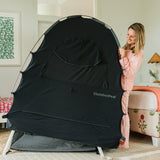
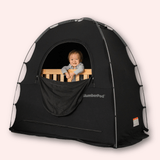
- SlumberPod creates a fully blackout sleep space — meaning it’s nighttime any time.
- Pro Parent Note: If you want to avoid light disruptions altogether (especially during sleep training), it’s a powerful tool. No towels on windows. No guessing. Just consistent darkness that tells your baby: it’s time to sleep.
Final Takeaway?
You can’t control the clocks. But you can control:
✔ Routine
✔ Environment
✔ Consistency
Spring forward without falling behind — and make it feel like nighttime anytime. You’ve got this. 🌷